
|
|
The Psychology of Terrorism 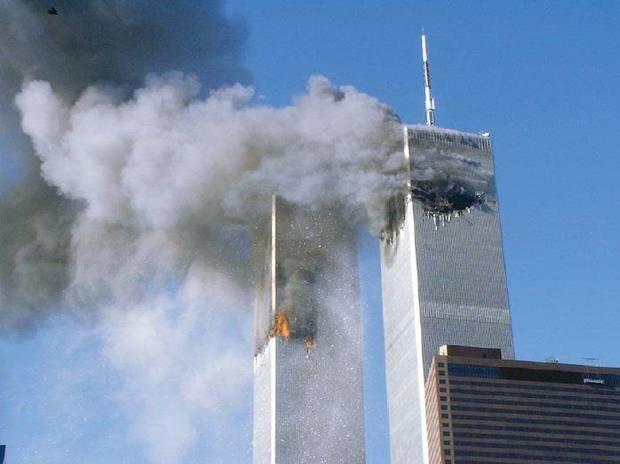
by Randy Borum, Psy.D. Twin Towers on fire. 9/11. Photo courtesy FEMA (Public Domain) |
A continuing education course for 4 ces consisting of reading and taking a post-test on:
Psychological Vulnerabilities and Propensities for Involvement in Violent Extremism
and
Psychology
of Terrorism
Randy
Borum, Psy.D.
Psychological Vulnerabilities and Propensities for Involvement in Violent Extremism Research on the psychology of terrorism has argued against the idea that most terrorist behavior is caused by mental illness or by a terrorist personality. This article suggests an alternative line of inquiry – an individual psychology of terrorism that explores how otherwise normal mental states and processes, built on characteristic attitudes, dispositions, inclinations, and intentions, might affect a person's propensity for involvement with violent extremist groups and actions. It uses the concepts of "mindset" – a relatively enduring set of attitudes, dispositions, and inclinations – and worldview as the basis of a psychological "climate," within which various vulnerabilities and propensities shape ideas and behaviors in ways that can increase the person's risk or likelihood of involvement in violent extremism. Randy Borum. "Psychological Vulnerabilities and Propensities for Involvement in Violent Extremism" Behavioral Sciences and the Law Vol. In Press (2014) |
Psychology of Terrorism As
part of the ongoing effort to better understand the causes, motivations
and determinants of terrorist behavior, based on a comprehensive
review of the scientific and professional literature, this report
analyzes key findings on the “psychology of terrorism.” |
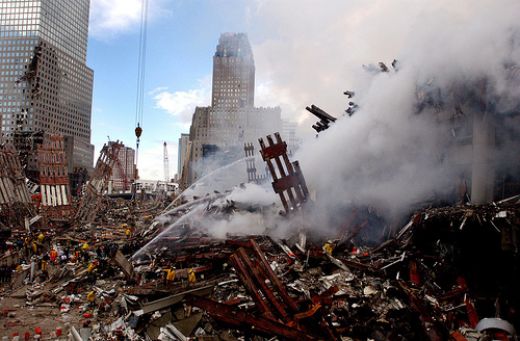
Fires still burn amidst the rubble and debris of the World Trade Centers
in New York City in the area know as Ground Zero two days after the 9/11
terrorists attacks.
DoD photo by: PH2 JIM WATSON, USN Date Shot: 13 Sep 2001
maintains responsibility for the program. |
|
The
Psychology of Terrorism 1.
Review psychological approaches to understanding violence
|
| Introduction In the current national security environment, there is little question that terrorism is among the gravest of threats. Massive resources throughout the government and private sectors have been allocated and re-allocated to the task of preventing terrorism. These efforts, however, often lack a conceptual - let alone empirically-based – foundation for understanding terrorists and their acts of violence. This void creates a serious challenge at many levels, from policy-level decisions about how a state should respond to terrorism, to individual-level decisions about whether a given person of interest, who espouses extremist ideas, truly poses a serious threat to U.S. personnel, assets, and interests. The purpose of this paper is to analyze and synthesize what has been reported from the scientific and professional literature about the “psychology of terrorism.” This focus is not intended to suggest that the scientific discipline of psychology provides the only, or even necessarily the best, analytic framework for understanding terrorism. Like all approaches to understanding or explaining human behavior, a psychological approach has advantages and limitations. Nevertheless, as psychology is regarded as “the science of human behavior,” it seems a reasonable, and potentially productive, line of inquiry. Although the basic question of how best to define terrorism has itself been a vexing problem, for purposes of this analysis, we are concerned generally with acts of violence (as opposed to threats or more general coercion) intentionally perpetrated on civilian non-combatants with the goal of furthering some ideological, religious or political objective. Our focus on psychological dimensions, de-emphasizes analysis of sociologically-based explanations (sometimes referred to as “root causes”) or macro-level economic and political theories. Moreover, our focus on terrorist acts de-emphasizes analysis of the psychological effects, consequences or amelioration of terrorism. In many ways, our basic aim is rather modest. We do not anticipate identifying or discovering THE explanation for all terrorism. Rather, we hope to identify, describe, and evaluate what contribution – if any – psychological theory or research may have made to understanding terrorists and terrorism. In approaching this task, we are mindful of Walter Laqueur’s incisive conclusion based on more than a quarter century of personal research on the topic: “Many terrorisms exist, and their character has changed over time and from country to country. The endeavor to find a "general theory" of terrorism, one overall explanation of its roots, is a futile and misguided enterprise. ..Terrorism has changed over time and so have the terrorists, their motives, and the causes of terrorism.” (Laqueur, 20031). Psychiatrist Jerrold Post makes that caveat even more directly applicable to an exploration of the psychological dimension of terrorism. He cautions that “there is a broad spectrum of terrorist groups and organizations, each of which has a different psychology, motivation and decision making structure. Indeed, one should not speak of terrorist psychology in the singular, but rather of terrorist psychologies” (Post, 20012). With that cautionary note, we offer the following review. |
| TABLE OF CONTENTS Executive Summary Introduction Aims & methodology Psychological approaches to understanding violence Instinct Theories Drive Theories (Frustration – Aggression) Social Learning Theory Cognitive Theory Biological Factors Raw Empirical Approaches First generation psychological research on terrorism Psychoanalytic Theory Narcissism Early Typologies Contemporary psychological research on terrorism How and why do people enter, stay in, and leave terrorist organizations? To what extent is psychopathology relevant for understanding or preventing terrorism? To what extent is individual personality relevant for understanding or preventing terrorism? To what extent are an individual’s life experiences relevant for understanding or preventing terrorism? What is the role of ideology in terrorist behavior? What distinguishes extremists who act violently from those who do not? What are the vulnerabilities of terrorist groups? How do terrorist organizations form, function, and fail? Conclusions on the state of research References |
This course consists of reading and taking a post-test on:
The Psychology of Terrorism
All material appearing in this volume except that taken directly from copyrighted sources is in the public domain and may be reproduced or copied without permission from the Substance Abuse and Mental Health Services Administration's (SAMHSA) Center for Substance Abuse Treatment (CSAT) or the authors. Citation of the source is appreciated.

Dr. Randy Borum is a Professor in the College of Behavioral and Community Sciences at the University of South Florida, where he holds a joint appointment the College of Public Health. He recently served on the Defense Science Board Task Force on Understanding Human Dynamics, and as a behavioral scientist and Board-Certified Forensic Psychologist researching national and global security issues, he regularly teaches and consults with law enforcement agencies, the Intelligence Community, and DoD, and has authored/ co- authored more than 120 professional publications. Dr. Borum has been an instructor with the BJA State & Local Anti-Terrorism Training (SLATT) Program since 1999, and worked as a Senior Consultant to the U.S. Secret Service for more than a decade helping to develop, refine and study behavior-based protocols for threat assessment and protective intelligence. He has previously served as a sworn police officer, Forensic Coordinator for a regional state psychiatric facility, and as full-time faculty at Duke University Medical School. He has taught at the FBI Academy, FLETC; JFK Special Warfare Center and School (Ft. Bragg); Joint Special Operations University; CIA; and the US Army Intelligence Center and School (Ft. Huachuca). He was Principal Investigator on the Psychology of Terrorism initiative for an agency in the US Intelligence Community. He serves as an advisor to the FBI's Behavioral Science Unit and FLETC Behavioral Science Division, and is listed on the United Nations' Roster of Experts in Terrorism. He is also consultant to the DIA's Defense Counterintelligence and Human Intelligence Center. Dr. Borum is a Past-President of the American Academy of Forensic Psychology, and currently serves as Associate Editor of the Journal of Strategic Security, and on the editorial boards of the American Intelligence Journal; Behavioral Sciences & the Law and Red Team Journal (online) |
We do adhere to the American Psychological Association's Ethical Principles of Psychologists. Our courses are carefully screened by the Planning Committee to adhere to APA standards. We also require authors who compose Internet courses specifically for us follow APA ethical standards. Many of our courses contain case material, and may use the methods of qualitative research and analysis, in-depth interviews and ethnographic studies. The psychotherapeutic techniques depicted may include play therapy, sandplay therapy, dream analysis, drawing analysis, client and therapist self-report, etc. The materials presented may be considered non-traditional and may be controversial, and may not have widespread endorsement within the profession. www.psychceu.com maintains responsibility for the program and its content. |
All material included in this course is either in the public domain, or used with express permission. |
Cost of the 4 unit course is $55
|
Thank you! |
888-777-3773
|
|
|
|

 CA BBS - California Board of Behavioral Science accepts our CE Provider Approvals through APA, NASW, and NBCC. Course meets the qualifications for hours of continuing education credit for LMFTs, LCSWs, LPCCs, and/or LEPs as required by the California Board of Behavioral Science
 Due
to the wonders of technology, the minute you submit your order over
our
Due
to the wonders of technology, the minute you submit your order over
our 


